What the CE mark means for car electronics
The CE mark is the manufacturer’s declaration that a product meets the EU directives that apply to it. It is not a certificate issued by an authority. Behind it there must be an EU declaration of conformity that lists the directives and standards, and a technical file with test reports. As the importer, the business that places the product on the EU market must keep these documents available and check that they are plausible.
For a buyer, the practical question is simple: which directives should appear on the declaration for this product, and do they?
The directives that usually apply
- EMC Directive 2014/30/EU covers electromagnetic compatibility. It applies to practically all electronics: dash cams, chargers, monitors, cameras, parking sensors, head units.
- RoHS Directive 2011/65/EU restricts hazardous substances such as lead, mercury and certain flame retardants in electrical and electronic equipment. It also applies to all of them.
- Radio Equipment Directive 2014/53/EU (RED) applies to anything that intentionally transmits or receives radio: Wi-Fi and 4G dash cams, Bluetooth FM transmitters, GPS trackers, wireless chargers, wireless CarPlay adapters, head units with Bluetooth. Under RED, the EMC and safety requirements are covered within the radio declaration.
- Low Voltage Directive 2014/35/EU applies only to mains-powered products in the 50–1000 V AC range, such as a charger with a mains plug or a 230 V floodlight. A 12/24 V car charger or dash cam does not fall under it.
A common error on supplier documents is a declaration that lists the Low Voltage Directive for a 12 V product and omits RED for a Wi-Fi model. Both are signs that the paperwork was copied from another product.
Product by product
| Product | Typical directives | Things to check |
|---|---|---|
| Dash cam without Wi-Fi | EMC, RoHS | Battery or supercapacitor; battery rules if lithium |
| Dash cam with Wi-Fi, GPS or 4G | RED, RoHS | Radio test reports for each band |
| 12/24 V USB car charger | EMC, RoHS | PD output and protection data from the manufacturer |
| Bluetooth FM transmitter | RED, RoHS | FM output power and frequency range |
| 15 W wireless-charging phone mount | RED, RoHS | Wireless power transfer is radio equipment |
| Android head unit | RED, RoHS | Installer may ask for UNECE R10 |
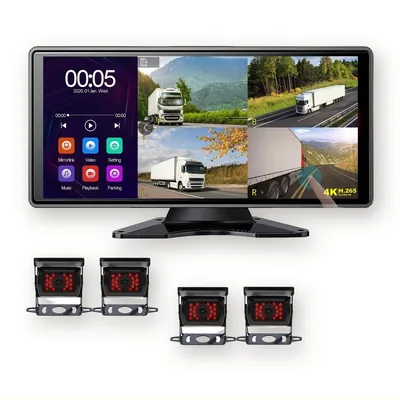
| Reversing camera, parking sensors | EMC, RoHS | Installer may ask for UNECE R10 |
This table is a starting point, not legal advice. The manufacturer’s declaration decides what applies, and we check it against the product.
When E-marking comes up
E-marking is a different system from CE. It comes from UNECE Regulation No 10, which deals with the electromagnetic compatibility of vehicles and of electronic sub-assemblies fitted to them. Devices that are permanently connected to the vehicle’s electrical system, such as head units, reversing cameras, parking sensors and flush-mount USB sockets, are where installers, fleets and dealers may ask for it.
Plug-in products that run from the cigarette lighter socket, such as most dash cams and USB chargers, are usually sold under CE alone. Some professional buyers still ask for R10 approval on every device in their vehicles, as a matter of internal policy.
Only some manufacturers hold E-mark approval, and only for specific models. We request the manufacturer’s certificate where it exists and tell you clearly when it does not. Do not assume a product is E-marked because a listing says so: ask for the approval number and check that it matches the model.
The documents to request
- EU declaration of conformity, signed, naming the exact model and the directives.
- Test reports for the listed standards, with the laboratory name and the model tested.
- For radio products, the reports covering each radio function: Wi-Fi, Bluetooth, GNSS, cellular, wireless power.
- RoHS test report or a material declaration.
- For battery products, the battery specification and UN38.3 test summary.
- Where it exists, the UNECE R10 approval certificate.
Check that the model name, the photos and the reports match. Reports for a different housing or an older chipset are a common gap. More on how we check documents is on our quality page.
Red flags in supplier paperwork
- A “CE certificate” from a company that is not a laboratory, with no test report attached.
- A declaration with no signature, no date or no model name.
- Reports that list only EMC for a product with Bluetooth or Wi-Fi.
- One report used for a whole family of models with different features.
- Test dates many years older than the current chipset or housing.
None of these proves the product is non-compliant, but each one means you need better documents before the goods are sold.
Marking on the product and the box
Besides the CE logo, an electronic product needs a type or model reference, a batch or serial number, the name and postal address of the manufacturer and of the EU importer, and the crossed-out bin symbol for WEEE. Safety information and instructions must be in the language of the country of sale. Where the product is too small, some of this can go on the packaging.
For private label, your brand becomes part of the marking. If you place the product on the market under your name, you take on the manufacturer’s obligations. That includes holding the declaration in your name. Our private label page explains how we handle that split.
Registration beyond CE
- WEEE: producer registration in each country of sale, for example stiftung ear in Germany or BDO in Poland.
- Batteries: producer registration and labelling under Regulation (EU) 2023/1542 for any product with a battery.
- Packaging: producer responsibility registration such as LUCID in Germany.
Marketplaces increasingly ask for these registration numbers before a listing goes live, so collect them before the stock arrives.
Usage rules are a separate matter
CE marking says a dash cam can be sold. It does not say it can be used in every way everywhere. Rules on recording public roads, storing footage and tracking vehicles differ between countries and follow data protection law. The buyer and the user are responsible for lawful use, and listings should not claim otherwise.
How we work with electronics
For each electronic product in our dash cam and electronics ranges we request the manufacturer’s declaration and test reports, check that they match the model, and provide them with the offer where they exist. If documents are missing, we say so before you order.