Which products in a car range contain batteries
More than buyers often expect. In a typical car accessories and garage range you find lithium-ion cells in:
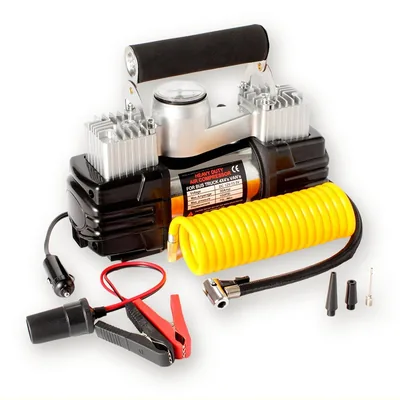
- cordless digital tyre inflators and inflators with jump starter;
- cordless impact wrenches, drill drivers, angle grinders and other power tools, with their battery packs;
- dash cams with an internal battery, GPS trackers and some wireless CarPlay adapters;
- rechargeable headlamps, LED floodlights on stands and inspection lights;
- cordless car vacuums.
Some dash cams use a supercapacitor instead of a battery. That changes both the compliance picture and the shipping, so ask the manufacturer which one is fitted.
The EU Batteries Regulation in short
Regulation (EU) 2023/1542 replaced the old Batteries Directive and applies to batteries sold on their own and to batteries built into products. Most batteries in car accessories and cordless tools are “portable batteries” under the regulation: sealed, under 5 kg and not designed for vehicle traction or industrial use. A large jump-starter pack or a heavy compressor battery may need a closer look.
The main obligations for a business placing these products on the EU market are:
- Producer registration in each country where the battery is made available, including batteries inside products. Each country runs its own register and take-back scheme.
- Labelling with the crossed-out bin symbol and, as the labelling rules phase in, information such as capacity and chemistry on the battery.
- Restrictions on substances such as mercury, cadmium and lead.
- Removability and replaceability of portable batteries in appliances, with requirements that apply from 2027. Products designed today with sealed, glued batteries may need a redesign or a different model choice.
The dates and details are still being filled in by implementing acts, so we check the current position for each product rather than rely on a summary.
Why removability matters for buyers now
From 2027, portable batteries in many appliances must be removable and replaceable by the end user with commonly available tools, with some exceptions. A power tool with a slide-on pack is already there. A cordless inflator or a headlamp with a glued-in cell may not be. If you plan a private-label line for the next few seasons, ask the factory about battery access before you fix the design. Changing a housing later costs a new mould and new samples.
Registration: WEEE and batteries together
A cordless inflator is both electrical equipment and a product with a battery. That usually means two producer registrations per country: one under WEEE for the device and one under the battery rules for the cell. In Germany, for example, both run through stiftung ear; in Poland, the BDO register covers producer obligations. Marketplaces may ask for the numbers before your listing goes live.
When you buy through an importer, check who the producer of record is in each country. When you sell under your own brand, the registration is often yours.
UN38.3: the test that decides shipping
Lithium batteries are dangerous goods in transport. Before they can be shipped, the cell and battery design must pass the tests in section 38.3 of the UN Manual of Tests and Criteria: altitude, thermal cycling, vibration, shock, external short circuit, impact, overcharge and forced discharge, depending on the battery. The manufacturer must make a UN38.3 test summary available, and carriers and forwarders ask for it.
Check that the summary names the right cell and battery, with matching capacity and watt-hours. A summary for a different pack, or for the cell only when the product uses a multi-cell pack, will stop a shipment.
How battery products travel
| Mode | What changes | Practical effect |
|---|---|---|
| Sea | Declared as dangerous goods under the IMDG Code | Usual route for larger battery orders; booking needs DG documents |
| Rail | Dangerous goods rules apply; not every service accepts them | Possible for mixed orders, depends on the operator |
| Air | Strict limits by battery size and packing; loose batteries most restricted | Samples and small lots only; not every route takes them |
| Road in the EU | ADR rules for the final leg | Labels and packing must stay intact through to your warehouse |
Batteries packed inside equipment are generally easier to ship than spare batteries packed on their own. If you sell spare packs for power tools, plan them for sea freight. Our logistics page explains how we route mixed orders.
Packaging and labels for battery products
- Lithium battery mark on the outer carton where the rules require it.
- Cartons strong enough for the weight, with products protected against short circuit and accidental activation.
- Crossed-out bin symbol on the product and battery.
- Charging and storage warnings in the language of the country of sale.
- GPSR data: model, batch, manufacturer and EU importer address.
What to ask a supplier
- Cell chemistry, nominal voltage, capacity in mAh or Ah and energy in Wh.
- Battery or supercapacitor, and whether it is removable.
- UN38.3 test summary and the MSDS for the battery.
- Battery charging circuit protection data and the charger specification.
- CE declaration for the device, including RED if it has wireless functions.
Common mistakes with battery products
- Booking air freight first. A late winter top-up of cordless inflators cannot always fly. Plan battery products into the main sea or rail shipment.
- Changing the battery without new papers. A factory that switches to a cheaper cell or a larger pack needs a new UN38.3 summary. Write the battery specification into the order and check it at inspection.
- Forgetting the spare packs. A power tool sold with two batteries and a charger has three items to label and register, not one.
- Listing before registering. Marketplaces and authorities check producer numbers. Registration in a new country can take weeks.
- Ignoring storage. Lithium products stored for a long time lose charge. Agree a state of charge for shipping and tell customers how to store and charge them.
Our approach
For battery products in our tyre inflator and power tool ranges we request the UN38.3 summary and battery data before quoting, plan the freight accordingly and tell you which registrations you need in your markets. We do not quote air freight for battery products without checking the route first.